Northfall
Achlys
Rating:
Unset
| Discord Tag: Tag Immediately
The Reaper
Profile Pages
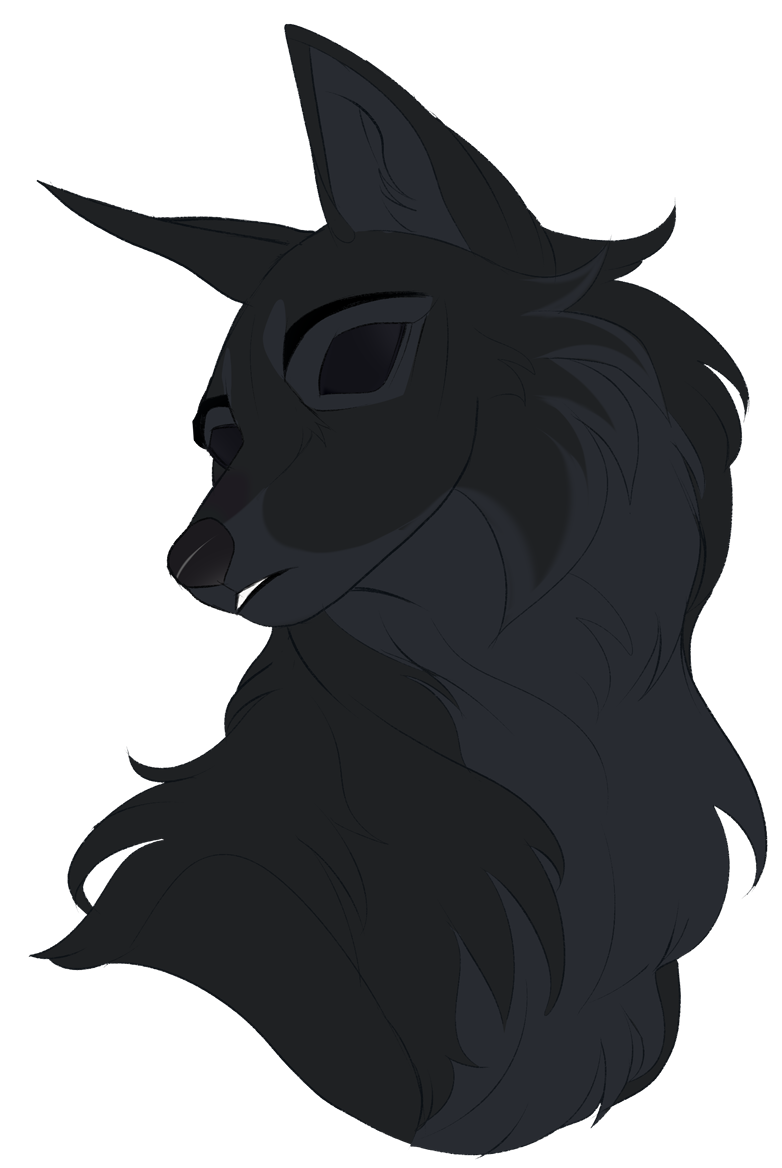

Achlys Kosa Callosum
Ack-liss
Species
Wolf
Age
1 year, 11 months
Birth Date
2024-10-31
Sex
Male (he/him)
Height
Tall
Weight
Light
Build
Scrawny
Scent
Hellebore & Funeral lillies
Eyes
No eyes
Fur
Black & slate grey
Traits
Wholesome • Unpredictable • Sadistic • Honorable • Foreboding • Cryptic • Sarcastic • Independent
Mark of Mythris
None
Death. And I don't mean it metaphorically or rhetorically or poetically or theoretically or any other fancy way

appearance
Achlys stands tall and long-limbed, his build scrawny at first glance but deceptively strong. Though he is light in weight, his body carries clean, defined muscle tone, especially along his shoulders, thighs, and abdomen. The muscle sits tight against bone rather than adding bulk, giving him a lean, tensile strength like wire drawn thin but impossible to snap. His legs are notably long, lending him a stalking, elongated stride that makes his movements feel deliberate.
His features are sharply angular and severe, high cheekbones, a narrow muzzle, and pronounced brow ridges that carve his face into stark planes of shadow and light. A thicker mantle of fur gathers at his neck and shoulders, adding faint volume to his otherwise narrow silhouette. Where eyes should rest are only smooth, empty sockets, dark and hollow without visible damage or scar tissue. The voids are calm rather than grotesque, eerily clean, giving him a presence that feels less wounded and more otherworldly as if sight is simply something he outgrew.
His features are sharply angular and severe, high cheekbones, a narrow muzzle, and pronounced brow ridges that carve his face into stark planes of shadow and light. A thicker mantle of fur gathers at his neck and shoulders, adding faint volume to his otherwise narrow silhouette. Where eyes should rest are only smooth, empty sockets, dark and hollow without visible damage or scar tissue. The voids are calm rather than grotesque, eerily clean, giving him a presence that feels less wounded and more otherworldly as if sight is simply something he outgrew.
I'm death. Straight up.
personality
Achlys stands out in any crowd, not through overt theatrics, but by the unsettling weight of his presence. He moves quietly, slipping between the edges of society with a calm confidence that borders on menacing. At first glance, he seems entirely unapproachable —his expressions are cool, his voice often laced with dry, sardonic wit that can make people’s skin crawl. This dark humor betrays his fascination with mortality, which he regards as an inescapable thread weaving through life’s tapestry. To him, death is neither horrifying nor tragic; rather, it’s a natural force that deserves awe and a certain grim respect.
Despite being unflinchingly harsh when provoked, Achlys is guided by a twisted sense of honor. He has strict personal rules that temper his darker impulses, ensuring his violence has purpose. If he spills blood, it’s usually because he believes the target is deserving of it—an oppressor, a threat, or someone who violates his moral bottom line. Brutality may come naturally to him, but it’s not unleashed indiscriminately. In this sense, he’s wholesome in an oddly pragmatic way. His interventions aren’t driven by soft-hearted empathy; rather, they’re cold, efficient acts of protection for those he deems vulnerable or worthy. He won’t cradle a wounded animal in his arms, but he’ll dispatch whatever threatened it without a second thought.
This delicate balance between brutality and a curious moral compass makes Achlys a bundle of contradictions. He dismisses societal norms with a wave, seeing them as flimsy constructs that fail to account for life’s harsher realities. While he’s quick to flout rules, he draws from an inner well of integrity that not even he can fully explain. There’s a reluctant caretaker in him—a watchman of the forlorn, stepping up when no one else will, even if his methods leave others uneasy. He rarely thanks or seeks thanks in return, and any kindness he displays tends to be raw, direct, and couched in gruff practicality.
The way he speaks mirrors his outlook: cryptic, clipped, and disconcertingly direct when he does bother to elaborate. Achlys doesn’t bother with social pleasantries; if he has something to say, he’ll say it plainly, then stand back to gauge the reaction with a faint smirk. People tend to misconstrue his bluntness as malevolence, but the truth is more nuanced. His curiosity about death and his unwavering self-reliance give him a perspective few others share, and that vantage point fosters detachment from everyday morality. Yet behind his cold delivery, there’s a faint glimmer of conviction—he truly believes in saving those who can’t save themselves, even if he meets this duty with a hollow laugh and a sharp edge.
Achlys is the embodiment of a shadow given conscience. He embraces the darkness of existence without sugarcoating it, acting as both judge and executioner for those who fall outside his moral lines. Simultaneously, he shoulders a silent guardianship, stepping in to shield others, albeit without the tenderness most would expect from a “hero.” He is the eerie twilight between black and white—a brutal enforcer of his own beliefs who, paradoxically, can be relied upon to do the right thing in the worst, most harrowing way imaginable.
Achlys Collosum
_

trivia
Achlys can visually 'see' by scent & these scents create colors and shapes in his mind that identify individuals & items, he can navigate and even fight quite well.
He does not realize/believe Sreda adopted him
Speaks Common & Russian fluently
Tends to 'stare' in ones general direction of their scent pattern
trivia
trivia
And I've come for you
— code by cj for aistiva. commission - do not recreate!!